
From Schiaparelli’s Lobster Dress to Saint Laurent’s Mondrian collection, some of fashion’s most memorable moments began in front of a painting. Here is what happened when designers took art off the wall, and what their choices can teach us about looking.
A Painting, Translated
In August 1965, Yves Saint Laurent presented a collection in Paris that would make two names famous at once: his own, and Piet Mondrian’s.
The idea began with a book. Saint Laurent’s mother had given him Michel Seuphor’s study of Mondrian for Christmas, and the grids of black lines and primary colours stayed with him. Of the 106 designs in his Autumn/Winter couture collection, 26 echoed Mondrian’s paintings.
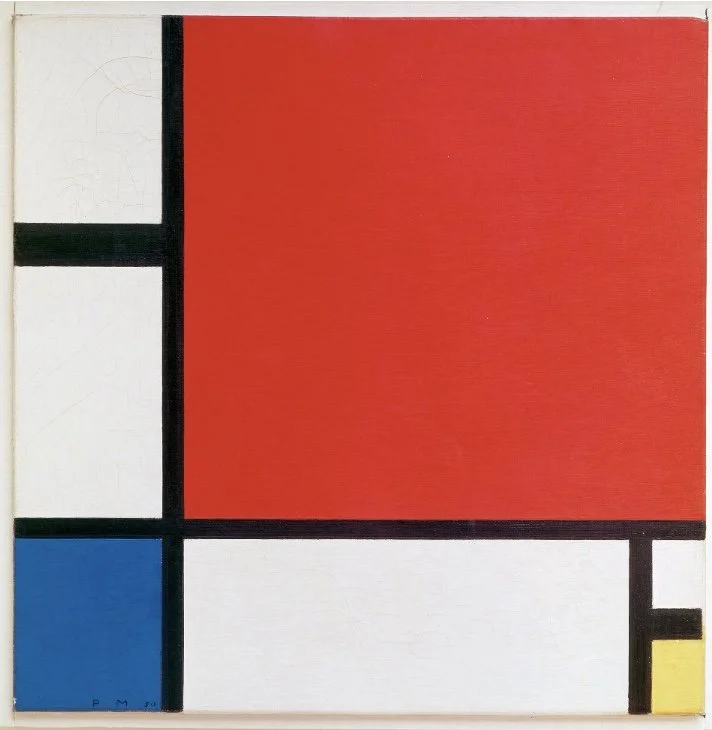
Piet Mondrian, Composition with Red, Blue and Yellow, 1930. Kunsthaus Zürich.
What looks simple was anything but. A painted grid is flat; a body is not. To keep the blocks of colour aligned as the wearer moved, Saint Laurent relied on carefully placed seams and darts, so that the structure of the dress and the structure of the painting worked as one.
The collection drew worldwide attention to both the designer and the painter. Four years later, in 1969, Mondrian was given his first retrospective in France, at the Musée de l’Orangerie in Paris.
A Lobster in the Wardrobe
Saint Laurent was not the first designer to look to the art world. Almost three decades earlier, Elsa Schiaparelli had gone further and worked directly with an artist.
In 1937, Salvador Dalí drew a lobster for her, and the silk designer Sache printed it onto an off-white silk evening dress. Dalí had been using lobsters in his work since 1934, most memorably in Lobster Telephone (1936).
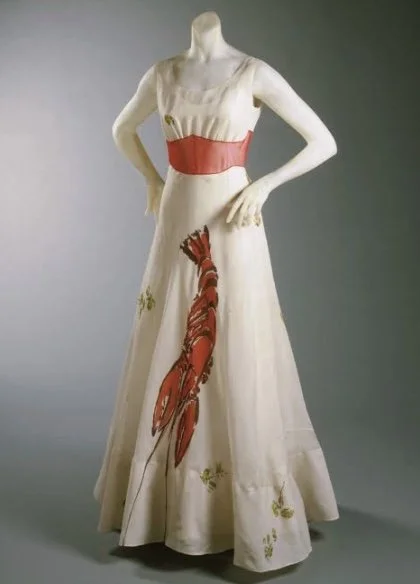
The dress might have remained a curiosity, but Wallis Simpson wore it in Cecil Beaton’s photographs for an eight-page Vogue spread in June 1937, shortly before her marriage to the Duke of Windsor, the former Edward VIII. Schiaparelli later gave her own example to the Philadelphia Museum of Art, where it remains today.
Van Gogh, in 250,000 Sequins
For his Spring/Summer 1988 haute couture collection, Saint Laurent returned to painting, this time to Vincent van Gogh. Two jackets became legendary: one embroidered with sunflowers, the other with irises.
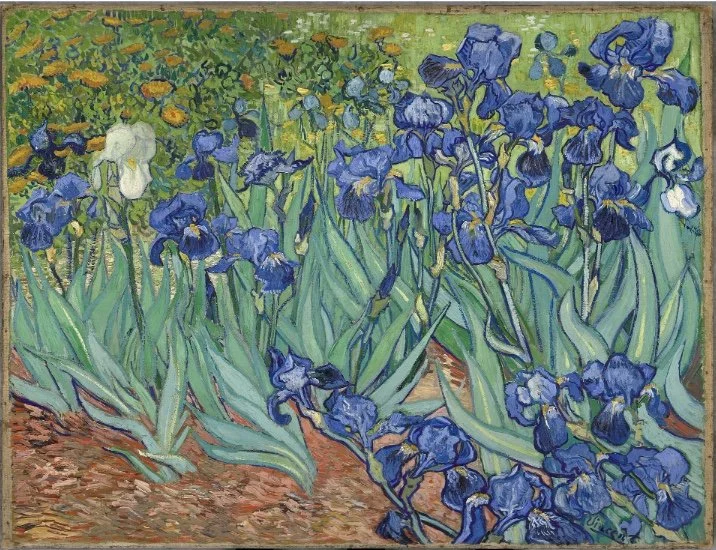
Vincent van Gogh, Irises, 1889. J. Paul Getty Museum, Los Angeles.
The embroidery house Maison Lesage spent more than 600 hours on the iris jacket, using around 250,000 sequins in 22 colours to recreate the movement of Van Gogh’s brushwork. Only four examples of each design are thought to have been made.
In 2019, one of the sunflower jackets sold at Christie’s in Paris for €382,000. In the same year, The Metropolitan Museum of Art acquired an iris ensemble for its Costume Institute.
Pop, Printed
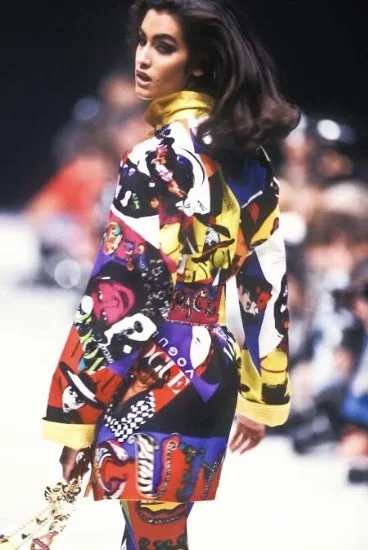
In 1991, Gianni Versace brought Pop Art to the runway. His Spring/Summer collection featured prints of Andy Warhol’s portraits of Marilyn Monroe and James Dean, worked in saturated colour across silk dresses and skirts.
Warhol had built his career on the idea that the line between fine art and commercial imagery was thinner than anyone liked to admit. Versace carried that idea one step further, from the gallery wall onto the body.
When the Runway Became Performance
At the end of Alexander McQueen’s Spring/Summer 1999 show, No. 13, the former ballerina Shalom Harlow stood on a revolving platform in a white dress while two robots, borrowed from a car factory, sprayed it with paint. She had not rehearsed. McQueen later said the moment was inspired by Rebecca Horn’s 1991 installation High Moon.
It remains one of the most famous moments in fashion, and one of the clearest examples of a designer thinking like an artist. The dress was not designed and then shown. It was finished in front of the audience.
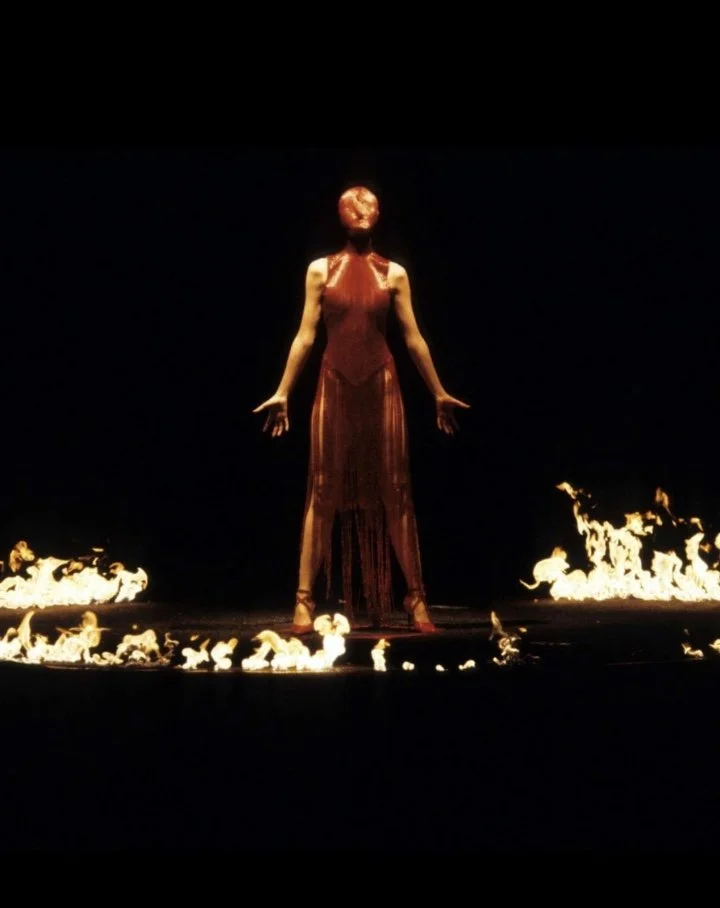
Alexander McQueen, Joan of Arc, Autumn/Winter 1998 © Condé Nast Archives. Courtesy Tate.
That spirit runs through The 90s: Art and Fashion at Tate Britain. Curated by Edward Enninful, it places collections by McQueen, John Galliano and Vivienne Westwood alongside work by artists including Damien Hirst, Sarah Lucas and Steve McQueen. It runs until 14 February 2027.
A Question, Worn
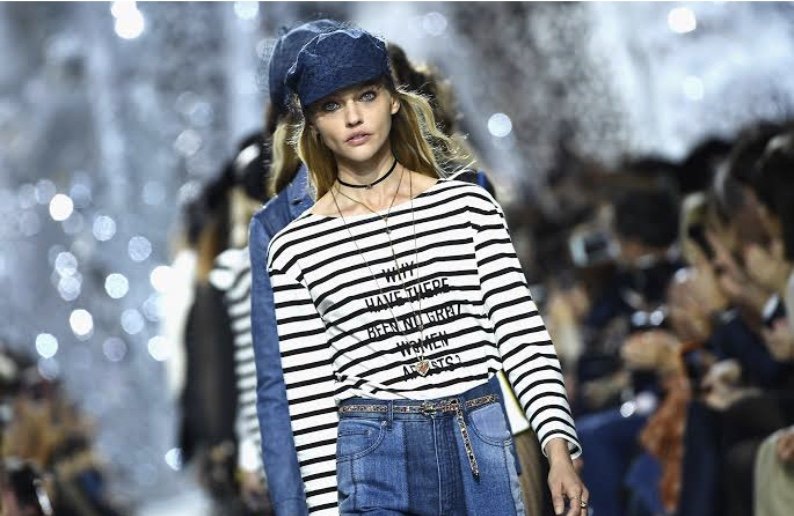
Fashion has also used art history to ask harder questions. In September 2017, Maria Grazia Chiuri opened Dior’s Spring/Summer 2018 show with a striped top bearing the title of Linda Nochlin’s 1971 essay: “Why Have There Been No Great Women Artists?”
The show itself was a tribute to Niki de Saint Phalle. The set recreated a mirrored space modelled on her Tarot Garden in Tuscany, and the collection nodded to her curving Nana sculptures. For one afternoon in Paris, one of the most influential essays in art history was being read on a catwalk.
Why Fashion Keeps Coming Back to Art
Why do designers return to painting again and again? Partly because a great artwork has already solved many of the problems a designer faces: how colours sit together, how a composition holds the eye, how a surface catches the light. Mondrian spent decades refining the balance of his grid. Van Gogh found a way to make paint itself seem to move.
But the most memorable moments are never simple copies. Saint Laurent had to reshape a flat grid around a moving body. Lesage translated brushstrokes into thread and sequins. McQueen turned the act of painting into theatre. Each time, the artwork changed in translation, and that change is where the new idea lives.
Bringing That Eye Home
There is a reason these moments still feel familiar. The instincts we use when we get dressed, choosing colours that work together, balancing proportion, noticing texture, are the same ones we use when we choose art for our walls.
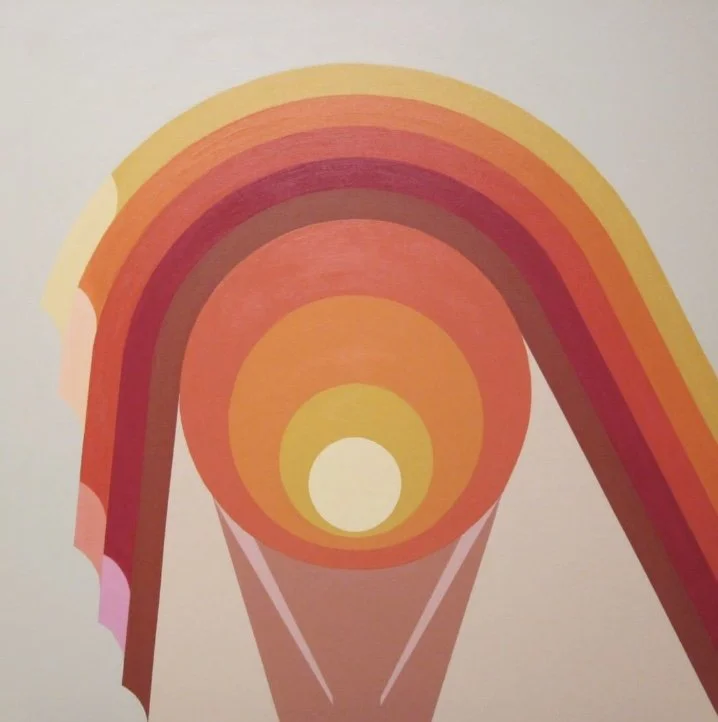
kenneth claes, MADRE DEL SOL. Acrylic on canvas, 76 × 76 cm. Available on NALA.
If you are drawn to clean lines and strong colour, look for works with the confidence of a printed silk, like kenneth claes’s MADRE DEL SOL, where bold bands of colour were inspired by the light of the Costa del Sol. If texture is what you notice first, consider pieces where the surface tells the story.
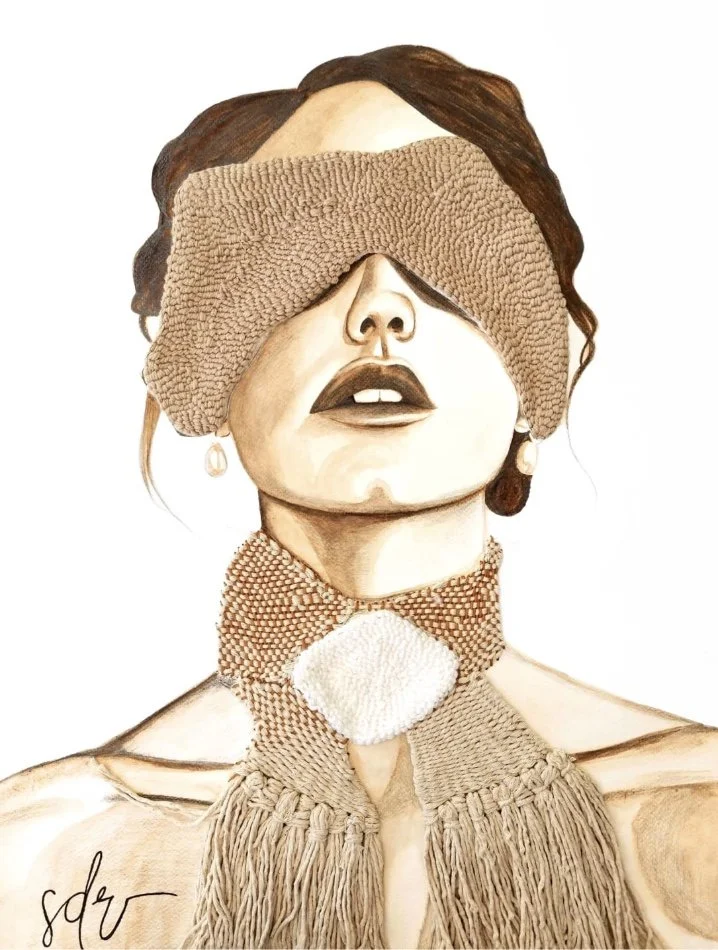
Sofia del Rivero, Introspection. Watercolour, graphite and embroidery on paper, 46 × 61 cm. Available on NALA.
Sofia del Rivero’s Introspection brings thread and embroidery into a drawing, a reminder that the conversation between textile and art runs in both directions.
In the end, the best works, like the best clothes, are the ones you keep returning to.
Explore original works by independent artists from around the world on NALA, and see this week’s edit of works chosen for a designer’s eye.