
AI Can Make the Asset. It Still Can’t Replace the Artist
NALA Founder Ben Gulak on the possibilities and limitations of AI in the Arts
As someone immersed in tech and AI, I spend a lot of time-consuming predictions about where all of this is going. Some of it’s exciting, a lot of it has been useful for figuring out how to implement things. But a lot of it is also doom and gloom, especially for people who make things for a living.
I have always considered myself a creator and an artist. I have always valued the ability to take an idea that does not exist yet and turn it into something real. So when tools like Midjourney and ChatGPT first launched, I leaned in hard. I loved them. I loved brainstorming with these new tools. I loved being able to prototype ideas quickly and move from a rough thought to a visual direction, a written draft, or a pseudo-code outline in minutes.
At first, AI felt like an accelerant. It could get me part of the way there, but not all the way. You still needed taste, you still needed judgment. You still needed skill, context, and the ability to know when something was wrong even if it looked polished.
As someone who re-enrolled in university before the AI wave (I actually studied Computer Science and Data Econometrics which became part of my schools AI program later), I remember looking back and thinking how different my education would have been if these tools had existed then. I spent hours debugging small problems that could now be solved almost instantly with OpenAI or Anthropic. I remember getting stuck not because I failed to understand the broader concepts, but because some minor implementation issue slowed everything down.
At the time, I thought: if I had AI when I was a student, I could have learned faster, experimented more, and spent more time experimenting with ideas instead of fighting syntax errors.
But recently, something has shifted.
The tools stopped feeling like assistants and started feeling more like independent agents. In programming especially, AI suddenly needed far less human oversight. It could take an idea, build the flow, debug the code, and produce something functional with surprisingly little intervention. That changed my workflows almost overnight. On one hand I was suddenly much more productive but also significantly less involved in the nuanced details.
This forced me to think about a harder question: what is creativity when an artificial system can take an idea and run the entire gamut? What happens when almost anyone can generate something that looks polished? What happens when the technical moat I thought I was building, including the value of an MIT education, starts to feel less exclusive than I expected?
I just watched an interview with Strauss Zelnick, CEO of Take-Two Interactive, the company behind Rockstar Games and Grand Theft Auto. His argument helped me reframe the issue.
He made a distinction between asset creation and hit creation and the distinction is important.
In his industry, AI can help create assets. It can produce a texture, a line of dialogue, a block of code, a concept image, a background, a draft, a character description, or a scene. It can generate parts of a thing.
But a hit is not just a collection of parts.
A hit requires taste, timing, risk, judgment, cultural awareness, and a clear point of view. It requires knowing what is worth making, not just having the ability to make it.
Zelnick pointed out that anyone could technically make a video game before AI. The tools already existed. Game engines existed. Tutorials existed. Asset stores existed. Distribution platforms existed. Thousands of games are released every year. Very few become hits.
That is the point. The bottleneck was never only access to tools. The bottleneck was knowing how to use those tools to create something people actually care about.
AI lowers the cost of execution. That is a big deal. It makes production faster, cheaper, and more accessible. But execution is not the same as originality. Speed is not the same as significance.
The line from the interview that stayed with me was: “Things that are data-driven in their entirety can’t be unexpected.”
That is the issue. AI is trained on what already exists. It learns from past writing, past images, past games, past code, past design, past taste. That makes it extremely powerful at recognizing patterns and producing variations. But creative breakthroughs are usually not obvious in advance. They often feel strange, risky, or uncomfortable before they feel inevitable.
AI is very good at resemblance. It can create something that looks like a famous style, sounds like a familiar genre, or feels like something that has already succeeded. But there is a difference between making a clone and making something original.
A clone may be impressive. It may even be useful. But it does not move culture forward.
I had my own version of this experience recently while writing a short story for a contest. I love fantasy and horror, and some of my favorite writers are Stephen King and Neil Gaiman. My imagination naturally leans toward darker themes, morally ambiguous characters, and scenes that are not always neat or comfortable.
I had had a dream that felt vivid enough to turn into a story. After writing a draft, I pasted it into OpenAI intending to run a grammar check.
That was all I wanted: grammar.
But it did not just fix grammar. It rewrote key scenes. It softened the darker moments. It removed some of the more unsettling details. It smoothed out lines that had personality. The result was cleaner and safer, but it was also flatter.
After probing why it had made those changes, the explanation was that it was improving clarity, reducing gratuitousness, and making the piece more accessible.
But those details were what made the story mine, the personal references and anecdotes reskinned became a median of blandness.
The rough edges were not mistakes. The darker moments were not a failure of clarity. The tension was part of the work. I realized that ChatGPT could never write a book like Pet Cemetery or the Stand or American Gods (some of my favorites) and I felt re-invigorated in human creativity. The experience made something clear to me: AI optimizes toward smoothness, but art is not smooth. AI often optimizes toward clarity, but, some creative work needs ambiguity. AI optimizes toward safety, but some of the most memorable work is memorable because it takes a risk, because it makes people question their beliefs.
I still use AI. I still think it is one of the most important technologies of our lifetime. But I think we need to be much clearer about the difference between using AI as a tool and using AI as a replacement for human creativity.
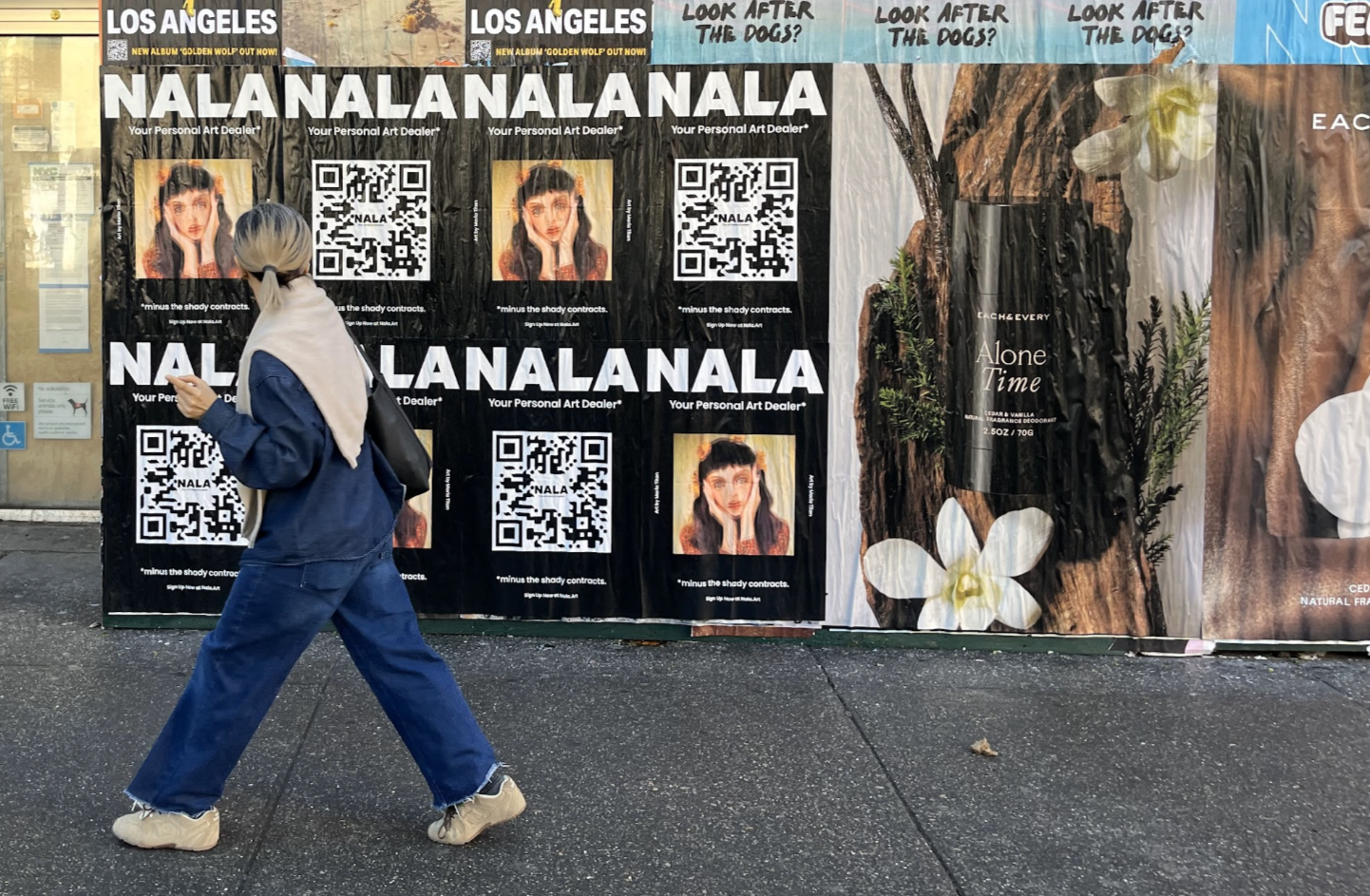
The danger is not simply that AI will make bad work. The bigger danger is that it will flood the world with work that is polished, plausible, derivative, and forgettable. This has also made me think about how NALA fits into the AI Data landscape. NALA is built around a different use of AI. It is designed to help people discover human-made artwork more intelligently.
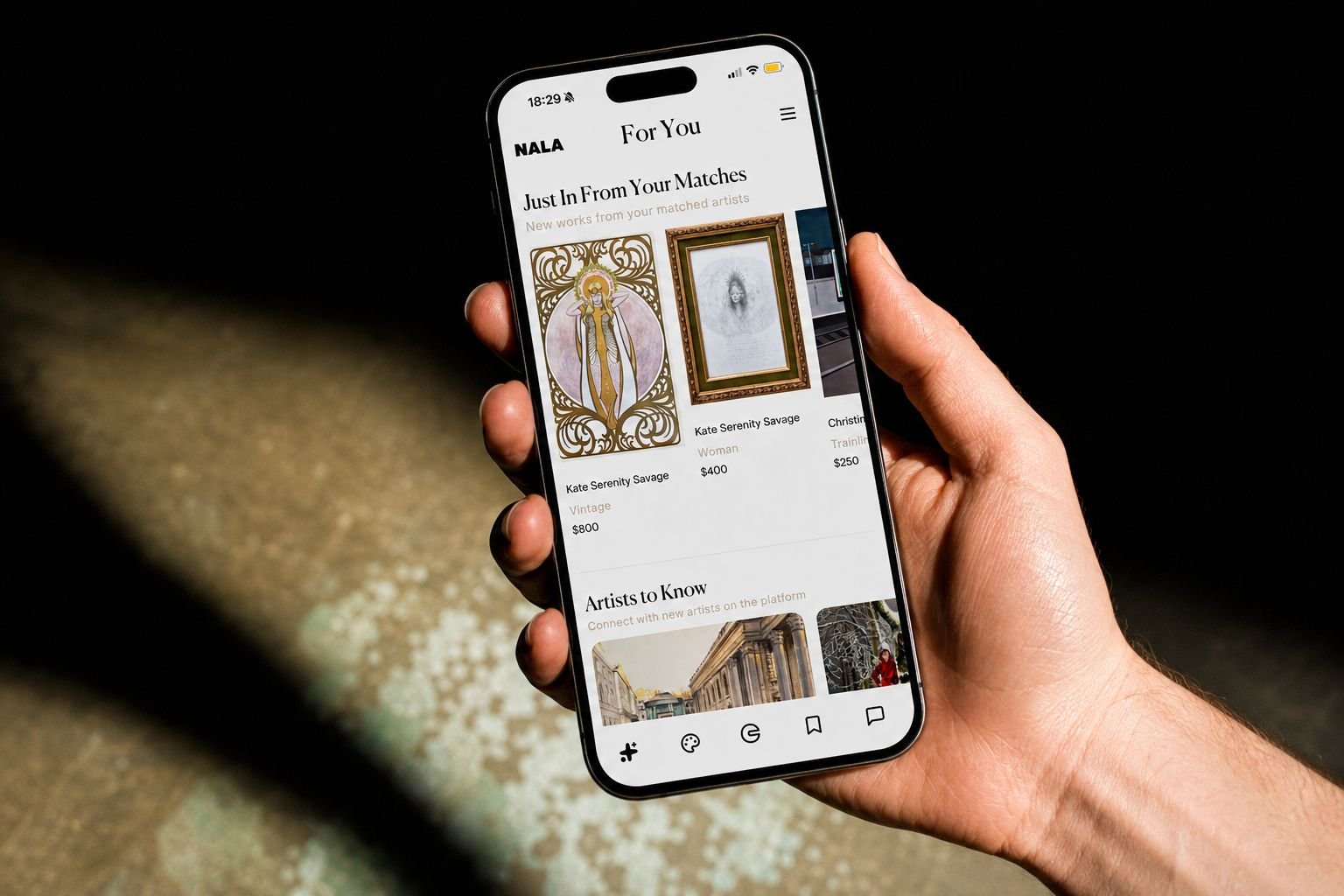
NALA uses AI-powered discovery to connect artists directly with art lovers, collectors, interior designers, and institutions. Tools like personalized feeds, Echo reverse image search, Voice Search, designer workflows, and direct artist-to-buyer messaging are all built around one goal: reducing the friction between artists and the people most likely to value their work.
That distinction matters.
There is a major difference between using AI to help someone find a painting they love and using AI to create endless synthetic images trained on the work of real artists.
One expands access. The other risks extraction.
I built NALA to be a platform for artists, by an artist. That means the technology should serve the artist, not erase the artist. It should help artists reach buyers beyond geography, gallery gatekeeping, tourism, and social media algorithms. It should make discovery easier without making the creator disposable.
That is why I am committed to ensuring that artwork uploaded to NALA will not be used to train generative models.
For me, that is not a minor product policy. It is a line. I am seeing weekly emails about companies we use for software that are announcing they are training a new model and are updating their terms and services.
Artists should not have to worry that the platform they use to sell and promote their work is quietly turning that work into training data for systems that may eventually compete with them.
The biggest AI companies are building models on the accumulated output of human creativity: books, images, paintings, photographs, music, code, essays, films, and design. That does not mean all AI is bad. But it does mean artists deserve consent, transparency, and control.
Artists are not raw material. Writers are not prompt fuel. Painters are not aesthetic inputs.
As AI-generated content becomes easier to produce, the value of authentic human-made work may become more important, not less. When anything can be generated, provenance matters. When anything can be imitated, originality matters. When the internet is filled with synthetic content, knowing who made something and why they made it becomes part of the value.
The future of art should not be infinite clones of what already exists. It should be better systems for helping original human work get discovered, protected, and valued.
AI can make the asset.
But the artist creates the meaning.
That is the difference I want NALA to stand for.