
How Collectors Find Artists Now
Discovery used to run through a handful of gatekeepers. The latest data shows how quickly that changed, and what it means for anyone starting to collect.
For most of the modern art world's history, finding an artist worked one way. A gallery decided who earned a place on its walls. An advisor decided which of their clients received the call about a new name worth watching. Auction houses, fairs, and a small circle of critics and patrons handled the rest. The list of people in the room was short, and it mostly stayed that way by design. Discovery was something granted to you, if you were close enough to the center to receive it.
That model has not vanished, but it has lost its monopoly. The most recent Art Basel and UBS Survey of Global Collecting, published in late 2025, describes an art world where collectors increasingly find artists on their own, through the same feeds and phones the rest of us use all day. The shift is not subtle, and it happened faster than the trade tends to admit.
The number that tells the story
Consider a single figure. In 2022, 43 percent of high-net-worth collectors bought work by an artist they had only recently discovered. By 2025, that share had climbed to 66 percent. In three years, the appetite for discovering new artists went from a minority habit to a majority one.
This is the clearest sign that the discovery layer of the art world has opened up. Collectors are no longer waiting to be introduced to the next name. They are going looking, and they are buying what they find.
Where the looking happens
Much of it happens on a screen. Among collectors who bought from a gallery, 51 percent made at least one purchase through Instagram, up from 41 percent two years earlier. A striking number of them bought the work without seeing it in person first. The platform that began as a place to share images has become a place to buy them.
This does not mean galleries have disappeared. They remain the most used channel in the market by a wide margin. What has changed is that the gallery is now one door among several, rather than the only one. Collectors move fluidly between a fair booth, a studio, an Instagram post, and a private viewing, often for a single acquisition. Discovery has become something that happens across all of these at once.
A different kind of collector
The reason for the shift is partly generational. Nearly three-quarters of the collectors surveyed are now Millennials or Gen Z. They are the first collectors to have grown up online, and it shows in how they build knowledge. Rather than relying on a single advisor, they research across feeds, peer networks, group chats, and the occasional expert, assembling their own picture of who and what matters. The old hierarchy, in which taste flowed downward from a few authorities, has flattened into something wider and more social.
Women are shaping this moment as well. The survey found female collectors more willing than men to back artists they had newly discovered, and more likely to spend on work by women. For a generation that treats collecting as an extension of identity rather than status, discovery is not a risk to be managed. It is the entire point.
Closer to the artist
As the gatekeepers lost their exclusive hold, the distance between collector and artist began to close. Direct-from-artist buying has moved from the margins toward the mainstream. In the most recent survey, 43 percent of collectors bought work directly from a studio and 37 percent commissioned work themselves. Studio visits are rising year over year. Collectors increasingly want to know the person behind the work, not only the dealer who represents them.
This is the part that would have been hardest to imagine a generation ago. The relationship that once required an introduction now often begins with a message.
What it means for finding your own art
Put all of this together and a simple truth emerges. Finding art is no longer something done for you. It is something you do.
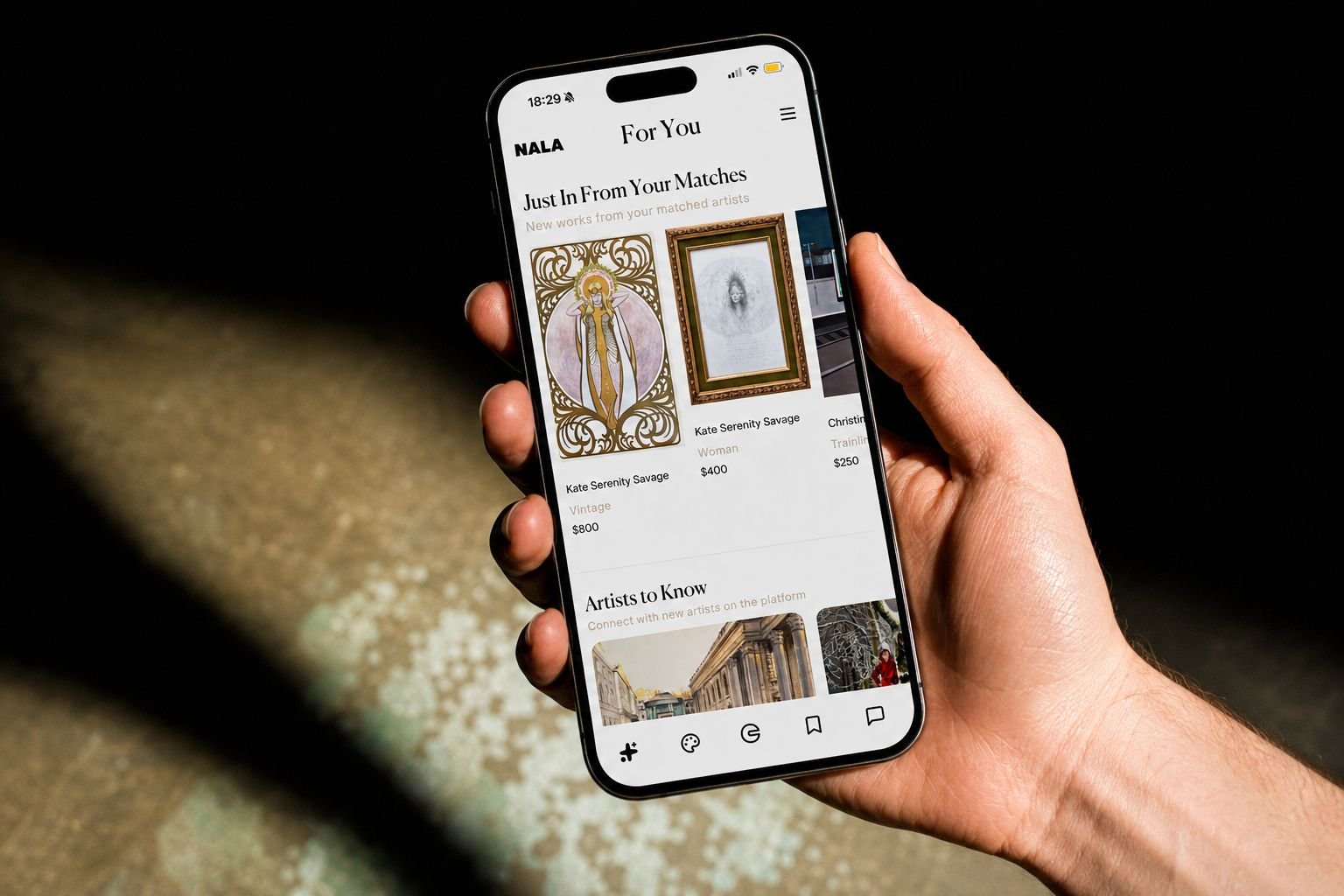
That is a real shift in power, and it comes with a new challenge. When discovery ran through gatekeepers, the difficulty was getting access. Now that access is nearly universal, the difficulty is attention. The feeds are endless. The number of artists worth knowing is larger than any one person can track. The question is no longer who lets you in. It is how you find the work that is actually yours, the pieces that feel less like a purchase and more like recognition.
That question is the one worth building around. Discovery has been handed back to the people doing the looking. What they need now is a better way to look.
Sources
Art Basel, Seven takeaways from the 2025 Survey of Global Collecting (2025): https://www.artbasel.com/stories/art-market-survey-of-global-collecting-2025-female-digital
Art Basel, The Art Basel and UBS Survey of Global Collecting 2025 (2025): https://www.artbasel.com/stories/the-art-basel-and-ubs-survey-of-global-collecting-2025