
For four centuries, painters have turned to the rooms they lived in: a courtyard in Delft, a dressmaker’s workshop in Paris, an attic on the rue du Cherche-Midi, a studio washed in red. What they found there says as much about looking as it does about home.
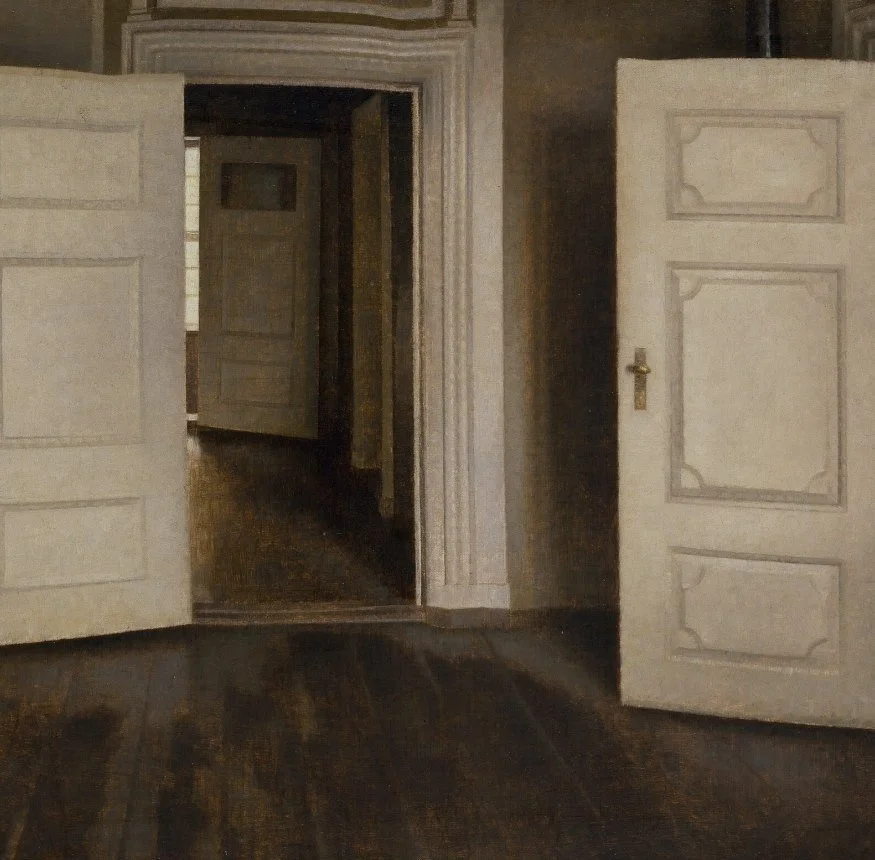
Vilhelm Hammershøi, White Doors, Strandgade 30, 1905. The David Collection, Copenhagen.
In the winter of 1898, Vilhelm Hammershøi moved into an apartment on the first floor of a seventeenth-century merchant’s house in Copenhagen and found the subject of his life. For the next eleven years he painted its doors, its panelled walls and the light that crossed its floorboards, often with his wife, Ida, turned away from us. He rearranged the furniture before he painted and took most of it away. What remained was a room reduced to its essentials, and a question that painters had been asking for centuries: what is it about a room that is worth looking at for so long?
Hammershøi was not the first to ask it, and he would not be the last. The interior is one of the oldest and most persistent subjects in Western painting, and, in its way, one of the most radical. It has served as a stage for domestic virtue, a laboratory for colour, a portrait of a mother, a refuge for an artist in love and, in one famous case, a canvas almost entirely covered in red. Following the painted room from Delft to the Côte d’Azur is a way of understanding how painters think, and why a painting of a room can change the room it hangs in.
A door left open: the Dutch interior
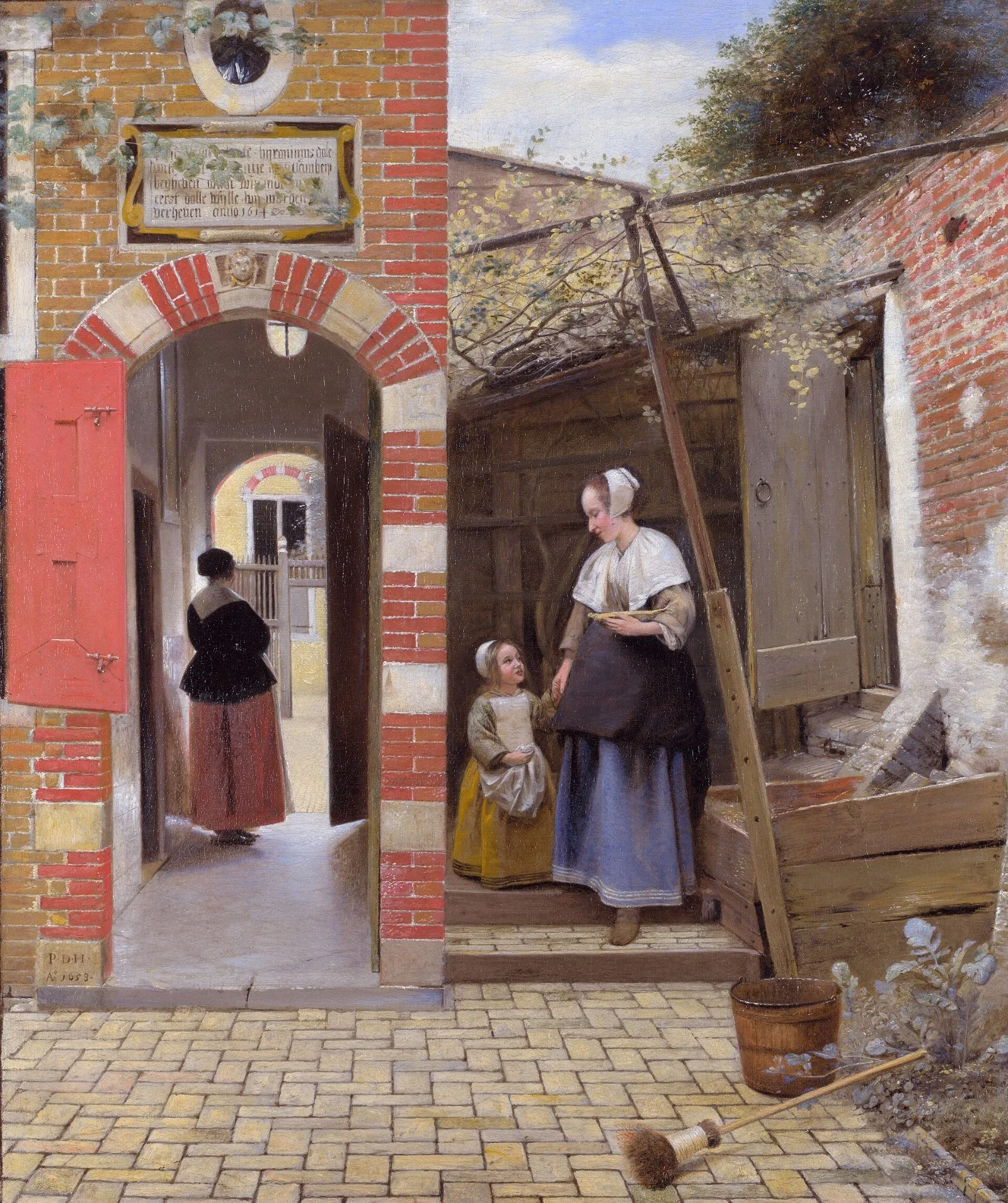
Pieter de Hooch, The Courtyard of a House in Delft, 1658. The National Gallery, London.
The modern interior begins in the Dutch Republic of the seventeenth century, when a prosperous merchant class wanted pictures of the lives it was building. In Delft in the late 1650s, Pieter de Hooch painted courtyards and parlours of extraordinary calm. His signature device was the open door: a passage at the back of the picture leads into another room, a yard or the street, so that the eye travels through the house as if walking it. The Dutch even had a word for these glimpses, doorkijkje, a view through a doorway.
His contemporary in Delft, Johannes Vermeer, took the idea inward. Vermeer’s rooms are lit from a window on the left, furnished with maps, tiled floors and heavy rugs, and occupied by women absorbed in a letter, a jug of milk or a piece of lace. Very little happens. That is precisely the point. These pictures made attention itself the subject, and they set a standard that interior painters have measured themselves against ever since.
Hammershøi knew this inheritance well. He admired Vermeer, and his grey-and-white rooms, lit from the side and inhabited by a single figure, are in many ways a Dutch interior with the narrative removed. Critics have often compared them to the ‘symphonies’ of James McNeill Whistler, paintings organised around tone rather than story.
The workshop at home: Vuillard and his mother
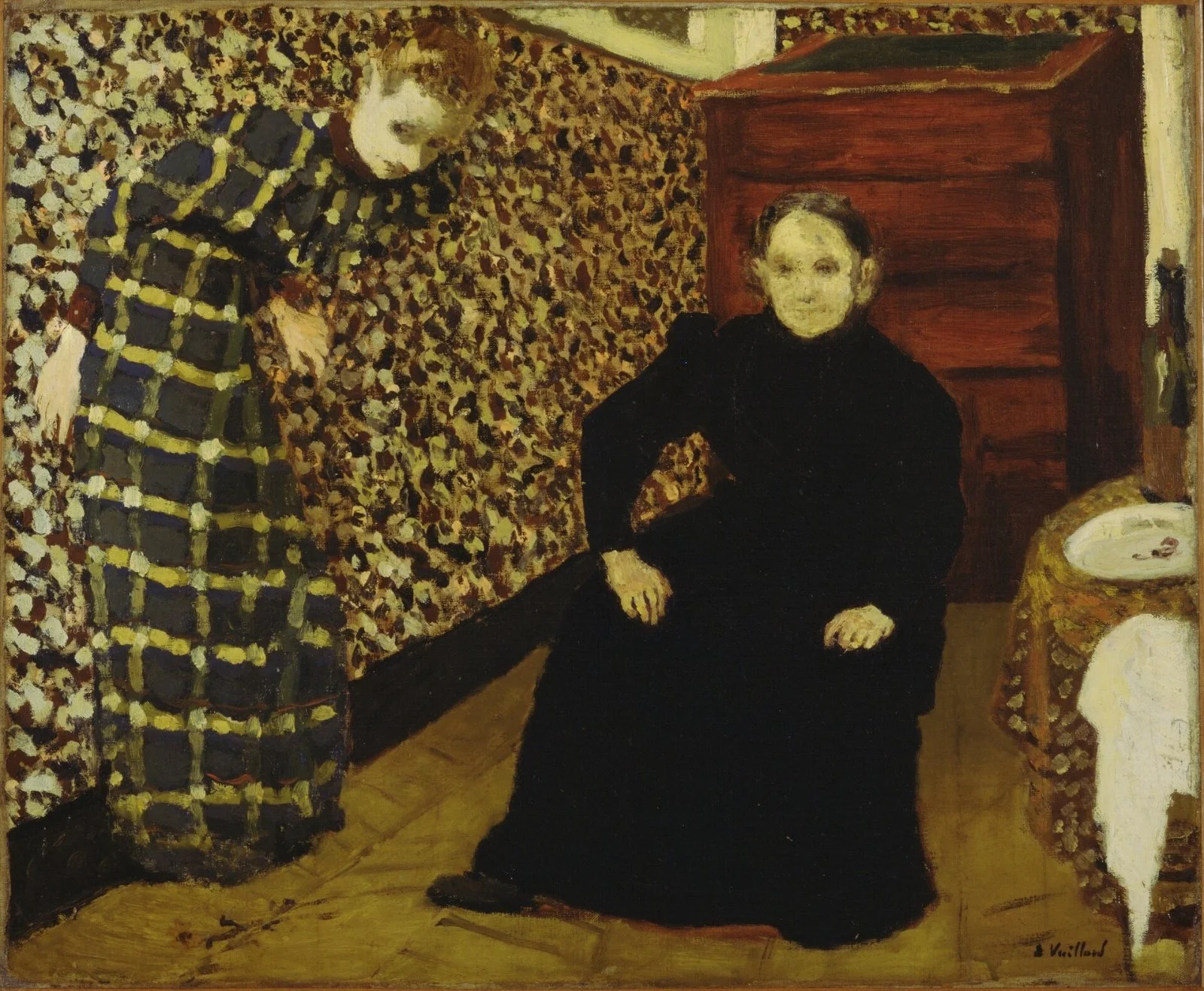
Édouard Vuillard, Interior, Mother and Sister of the Artist, 1893. The Museum of Modern Art, New York.
Two centuries later in Paris, the interior became something closer and stranger. Édouard Vuillard grew up in a dressmaker’s workshop. After his father’s death, his mother supported the family by running a corset-making and dressmaking business from their apartment, and Vuillard lived with her until her death in 1928. Bolts of patterned fabric, sewing tables, screens and wallpaper were the furniture of his childhood, and they became the language of his painting. He is said to have painted his mother some five hundred times.
Together with his friend Pierre Bonnard, Vuillard became known as an Intimist: a painter of private, domestic life seen from very close. In Interior, Mother and Sister of the Artist (1893), now at the Museum of Modern Art, his mother sits solidly in black while his sister Marie, in a checked dress, seems almost to dissolve into the wallpaper behind her. Pattern presses against pattern; the room tilts. It is a portrait of a family told entirely through the space it occupies, and it shows how much tension a domestic interior can hold.
A room as a state of mind: Van Gogh in Arles
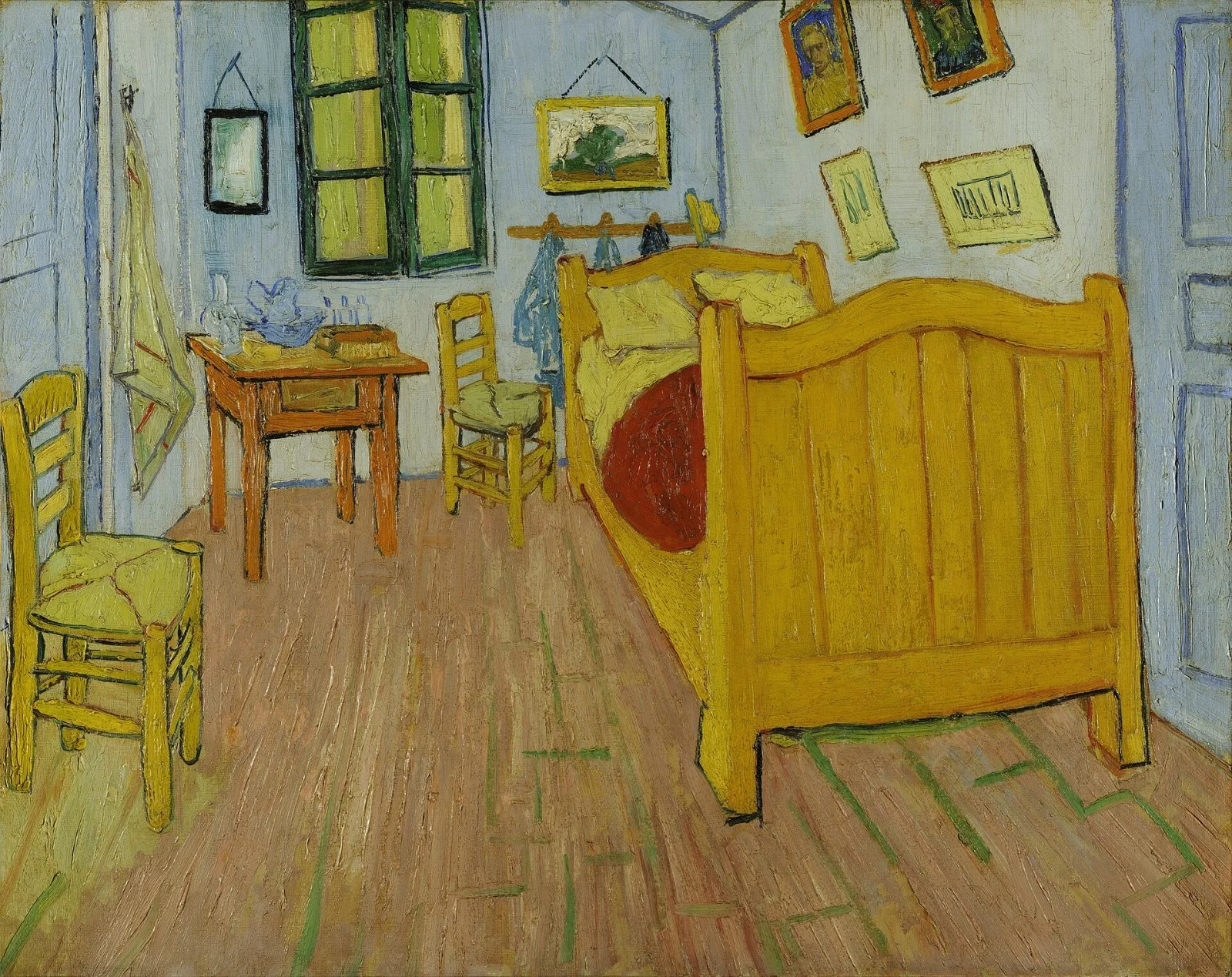
Vincent van Gogh, The Bedroom, 1888. Van Gogh Museum, Amsterdam (Vincent van Gogh Foundation).
In October 1888, recovering from a period of exhaustion in the Yellow House at Arles, Vincent van Gogh painted his bedroom. He described it to his brother Theo in a letter that remains one of the most precise accounts an artist has given of a painting: pale violet walls, a floor of red tiles, a bed and chairs in “fresh butter yellow”, a scarlet blanket, a green window. “Looking at the painting should rest the mind,” he wrote, “or rather, the imagination.”
Van Gogh was not recording a room so much as composing a feeling. The perspective is steep, the shadows are suppressed, and the colours are flat and strong, in the manner of the Japanese prints he loved. He was so pleased with the result that he painted the subject three times; the versions are now in Amsterdam, Chicago and Paris. The Bedroom is a reminder that an interior painting can describe an inner life as well as a physical space.
A room of one’s own: Gwen John in Paris
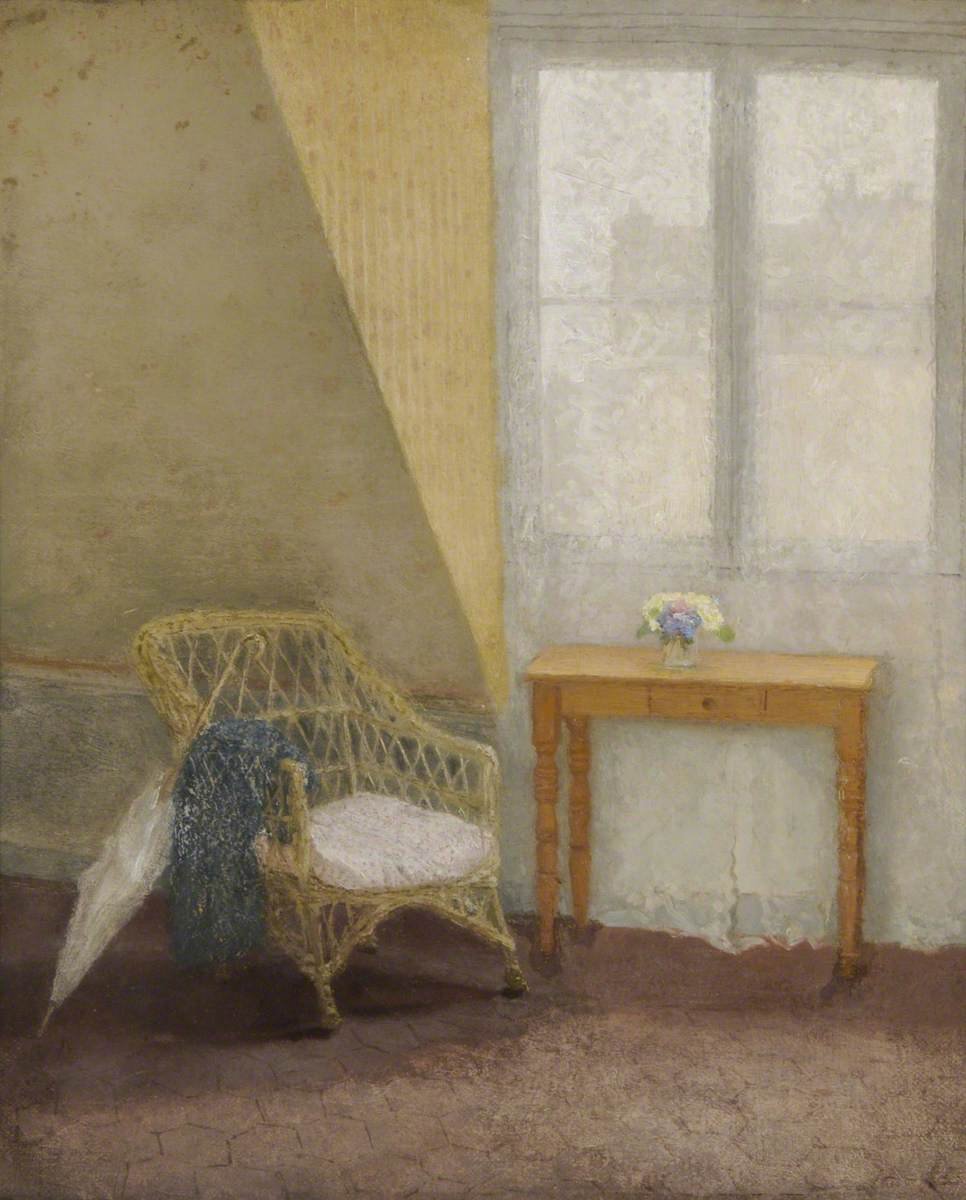
Gwen John, A Corner of the Artist’s Room in Paris, 1907–09. Museums Sheffield.
Between 1907 and 1909, the Welsh painter Gwen John lived in an attic room at 87 rue du Cherche-Midi in Paris. She painted a corner of it more than once: a wicker chair, a small table with a book or a vase, a window half open to the light. There is no figure, yet the room is unmistakably inhabited. The empty chair and the open book suggest someone who has just stood up.
John was proud of the room. “I must tell you,” she wrote, “what a feeling of contentment my room gives me.” Two versions survive, one in Sheffield and one in Cardiff, and they are often read as self-portraits in all but name. Two decades before Virginia Woolf wrote A Room of One’s Own, John painted one, and made the space of an independent working life into a subject worthy of art.
Colour as architecture: Matisse’s Red Studio
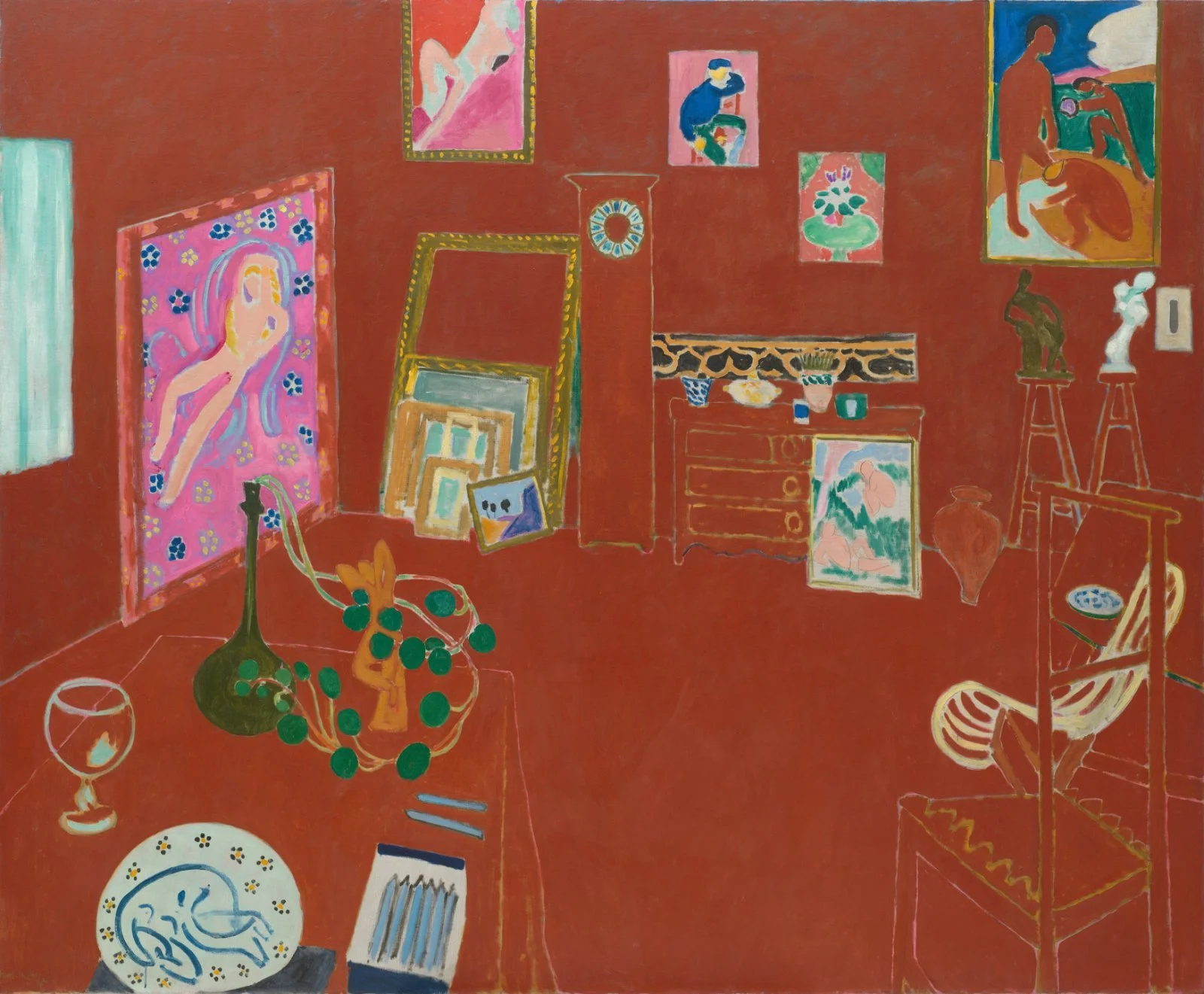
Henri Matisse, The Red Studio, 1911. The Museum of Modern Art, New York.
If Gwen John emptied the room, Henri Matisse dissolved it. In 1911, in the studio he had built in the grounds of his house at Issy-les-Moulineaux, outside Paris, he painted a view of the space filled with his own paintings, sculptures and furniture. Conservators have since found that he first painted the walls blue and the floor pink. Then, some weeks later, he covered almost the entire surface in Venetian red, an earth pigment of deep, slightly rusty warmth. Only the artworks kept their own colours, floating in the red like objects in water.
“The whole is Venetian red,” Matisse wrote to Sergei Shchukin, the Russian collector who had commissioned the picture. Shchukin declined it. The Red Studio remained unsold for years before the Museum of Modern Art acquired it in 1949, after which it became one of the most influential paintings of the century. It showed that an interior did not have to describe a room at all. Colour could become the room.
Living inside the picture: Bonnard at Le Bosquet
In 1926, Pierre Bonnard and his wife, Marthe, bought a small villa above Cannes, at Le Cannet, which they called Le Bosquet, ‘the grove’. Over the next two decades Bonnard painted the house, its garden, its dining table and its bathroom hundreds of times. Marthe appears again and again, often in the bath, often at the edge of the picture, half absorbed by the light on a tablecloth or a tiled wall.
Bonnard rarely painted directly from life. He made small pencil notes and worked from memory, which may explain why his rooms feel less observed than remembered: colours are heightened, spaces bend, and objects appear with the intensity of something recalled. In his late interiors the domestic room becomes a kind of paradise, and also, after Marthe’s death in 1942, a place of solitude. Few painters have shown so clearly that a room holds time as well as furniture.
Why the interior endures
Looked at together, these painters suggest why artists keep returning to the room. It is close at hand and endlessly available: the same space changes with every hour of light. It is private, so it can carry feelings that public subjects cannot. And it is a natural frame. Doors, windows, walls and floors give a painter ready-made geometry, a structure within which to test colour, tone and composition.
The subject has never gone away. Contemporary painters continue to work from their own kitchens, bedrooms and studios, and critics have written of a new Intimism among artists drawn to their private spaces. For many working artists the reason is practical as well as poetic: the room you live in is the one subject you can return to every day.
Hammershøi understood this better than anyone. Some sixty paintings came out of Strandgade 30, and the best of them have become some of the most sought-after works of Nordic art; his Interior with Woman at Piano, Strandgade 30 sold at Sotheby’s New York in 2017 for more than $5 million. A remarkable afterlife for a painter who kept taking the furniture out.
Living with a painted room
There is a particular pleasure in hanging a painting of an interior inside an interior. It opens a wall the way a window does, but onto another room, another light, sometimes another century. For collectors and interior designers alike, a few principles help.
Look for the light
Almost every great interior painting is organised around a single source of light: Vermeer’s window, Hammershøi’s sunbeams, Bonnard’s Mediterranean glare. When you are looking at a contemporary interior, notice where the light comes from and how consistently the artist has followed it. It is often the clearest sign of a painter who has really looked.
Notice the threshold
Doors, windows and passages are where interior paintings breathe. A work with an open door or a view beyond will add depth to a small room or a narrow hallway, in the way de Hooch’s courtyards lead the eye outwards.
Think about presence and absence
An interior with a figure, like Vuillard’s, feels inhabited and narrative. An empty room, like Gwen John’s corner, invites the viewer to step in. Both work beautifully, but they ask different things of a space: the first suits a living or dining room where people gather; the second rewards a study, a bedroom or a reading corner.
Let the palette converse with the room
A painted room does not need to match the real one, but the two will be in conversation. A grey Hammershøi-like interior deepens a pale, minimal space; a saturated interior in the spirit of Matisse can become the single point of colour in a restrained scheme. Hang it where the light in the painting and the light in the room agree, or deliberately contrast.
Discover interior paintings on NALA
Independent artists on NALA continue the tradition of the painted room: kitchens and studios, open windows, still lifes on a table in afternoon light. Search NALA for interiors, rooms or still life, or simply describe the room you want a work for, and buy directly from the artist who made it.
Frequently asked questions
What is an interior painting?
An interior painting depicts the inside of a building, usually a domestic room, sometimes with figures and sometimes empty. The genre flourished in the Dutch Republic in the seventeenth century and was transformed in the nineteenth and twentieth centuries by painters including Hammershøi, Vuillard, Bonnard and Matisse.
Who are the most famous interior painters?
Celebrated painters of interiors include Pieter de Hooch and Johannes Vermeer in the seventeenth century, Vilhelm Hammershøi, Édouard Vuillard, Pierre Bonnard and Gwen John around 1900, and Henri Matisse, whose The Red Studio (1911) transformed the genre.
What is Intimism?
Intimism describes the work of painters, especially Édouard Vuillard and Pierre Bonnard, who depicted private domestic life from very close: family members at home, meals, workrooms and bathrooms, painted with an emphasis on pattern, colour and atmosphere rather than precise description.
Why did Hammershøi paint the same rooms so often?
Hammershøi kept no separate studio, so his apartment at Strandgade 30 in Copenhagen became his principal subject. He rearranged and removed furniture to stage each composition, using the same rooms to explore light, proportion and stillness over many years.
How should I hang an interior painting?
Treat it like a window. Hang it where it extends a sightline or faces a doorway, at around 145 to 150 cm to the centre, and consider how the light in the painting relates to the light in the room.